
US Prospective Planting
- Tuesday April 14, 2009
This analysis featured in the April 14, 2009 issue of the HGCA's MI Prospects, Volume 11, Issue 20
Key Points
Next season's US production prospects for maize are close to those of this season, but the accumulation of ending stocks from 2008/09 will result in increased supply for next season. For soyabeans, average trend yields could increase supplies and result in a surplus to domestic needs similar to that of 2006/07, although prospective plantings are not materially different from this season. For wheat, even with the 7% decline in prospective plantings, US supplies, above continuing domestic needs, are likely to increase.
The USDA's Prospective Planting Survey report provides the first reliable indication of 2009 spring planting. And with this and trend average yields prospective supplies can be projected, albeit with a somewhat lower level of reliability. This article uses USDA projections for US domestic needs to gauge export supply prospects for next season.
Maize and Soyabeans - The 2009 Prospective Plantings report, published on March 31, of the survey undertaken in early March indicated relatively minor changes in area for maize and soyabeans but lower winter and spring sown areas. Planned sowings to all major crops is 3% lower at 102.9Mha, with the reduced area both in and beyond the Corn Belt. But the combined maize and soyabean area of 65.2Mha is about unchanged from the 2008 record area. This combined area has over the last five years increased by about 4Mha. This was mainly at the expense of cotton which is down by 7% but is also due to the use of more drought tolerant and shorter season varieties of maize and soyabeans at the geographic margin of the Corn Belt.
In the context of relatively recent experience, the ratio of maize to soyabean area is slightly less than in 2008 and much less than in 2007. The maize area is placed at 34.4Mha, down just 1.2% from last year and the soyabean area is placed at 30.8Mha, up 0.4% from last year (Table 1).
continue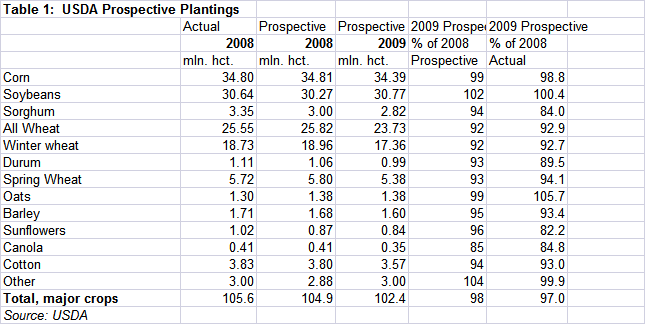
In general it is believed that the actual areas sown are going to be influenced by the price trends leading up to, and field conditions during, the planting season, as they impact on farmers' decisions. The reality is that in recent years actual areas sown have been close to the prospective planting indication, particularly where there has been limited change (Graph 1, 2).
continue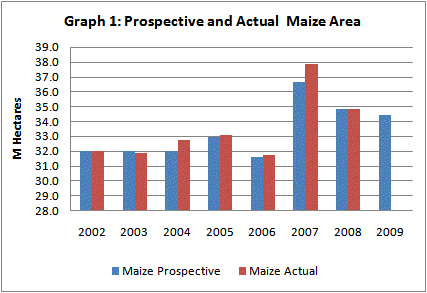
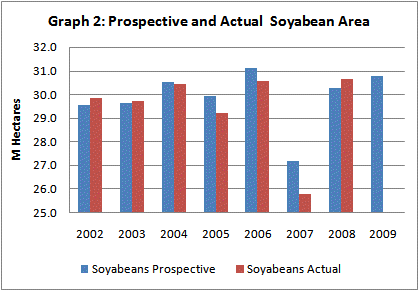
Price relationships are in a practical context secondary to agronomic and management consideration when allocating between the two crops and once a decision has been made not to change, there may be reluctance to go back on that decision at short notice. Further, the experience of 2007, when a record maize area was sown in a late season with, seemingly, no appreciable switch to short season soyabeans, suggests planting conditions would have to be very severe to have much influence.
What is of concern to many market observers is that statistically there appears to be close to about 1.5Mha of land unaccounted for in spring cropping areas in maize and soyabean growing areas. This is the sum of reduced soft red winter wheat, cotton and maize area less the small increase in soyabeans. Fallow and forage, which would not be expected to be significant in this context are not accounted for in the planting survey. More feasible is a reluctance of farmers to risk planting these row crops in marginal areas with the prospect of lower returns.
Wheat - Total wheat area is placed at 23.7Mha, down 7% from last year. Winter, durum and other spring wheat areas are down 7, 10 and 6%, respectively, at 17.4M, 1.0M and 5.4Mha. But the area sown to winter wheat was 2% higher than that reported in the USDA's January survey. Area in the hard red winter producing states is 12.5Mha (2% lower than last year) and in soft red winter states is 3.4Mha (25% down from '08). In the January Survey the USDA attributed much of the decrease in soft red winter wheats to the field work conflicts as a result of the late maize and soyabean harvests. The cut in wheat area this season puts it back in line with a declining trend evident prior to 2007.
It would be reasonable to expect that much of the land that came out of the Conservation Reserve Programme since then is to be signed in again. Prospective Export Supply - The prospective maize area was just 1% below both the USDA's February projection and last year's actual area. Using February's yield and domestic demand expectations, supplies surplus to those domestic needs for next season would be 5.4Mt and 6% smaller than anticipated in February and 4.6Mt and 5% smaller than for this season. Bearing in mind there is a 4.2Mt cumulation in ending stocks anticipated this year, the export supply situation at this stage does not look as though it will be materially different from this year. The demand side has yet to unfold.
continue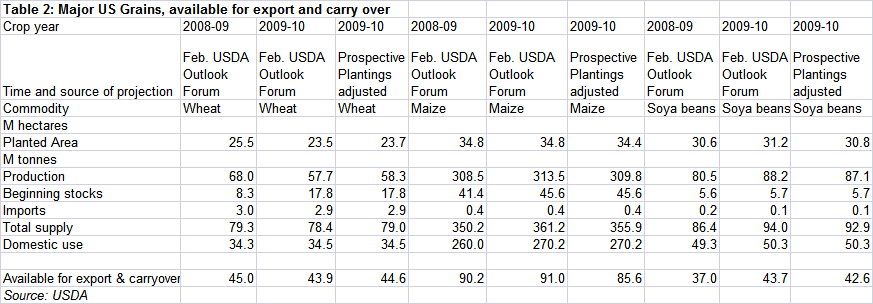
The prospective soyabean area was 1% below the USDA's February projection but 0.6% above last year's actual area. Using February's yield and domestic demand expectations supplies surplus to those domestic needs for next season will be 1.1Mt, 2.5% smaller than anticipated in February and 5.6Mt,15% larger than this season. Last season yields were below average. With only a marginal cumulation in ending stocks this year, next season's export supply, without factoring for demand, at this stage appears more liberal than for the last 2 years, but on a par with '06/07 when ending stocks rose 28%.
The wheat crop prospects, at least for winter wheat, are already emerging and crop abandonment has to be considered. While there are areas in the southern Great Plans that are suffering from drought conditions, moisture which is the most critical factor for wheat yields is generally favourable elsewhere. This is particularly so for most spring wheat growing areas in the northern Great Plains. The trend increase in average wheat yields is less than that for maize and soyabeans and so using the trend average yield is easier to accept.
The prospective wheat area was about 1% above the USDA's February forecast but 7% below 2008. With the assumption of trend average yields and US domestic needs as projected in February, wheat available for export and carry-over will be 0.7Mt and 1% above the February projection for next season but 0.4Mt below the forecast for this season. The doubling of ending stocks in this year's forecasts suggests that US wheat supplies will be more than adequate for the new crop season.
David Walker (001) 780 434 7615
top of page